Showing posts with label Buick. Show all posts

Wednesday, March 2, 2011

Buick Business Concept, 2009

Buick Business Concept, 2009


The Buick Business Concept, a new concept vehicle designed to showcase Buick's future vision of "business class on the road".

The multi-purpose vehicle (MPV) was developed in China by the Pan Asia Technical Automotive Center (PATAC), a design and engineering joint venture between General Motors and Shanghai Automotive Industry Corporation (SAIC), with global design input.
The Buick Business Concept Vehicle captures the essence of the Buick form language in a thoroughly elegant and expressive design, with its taut surfaces, double sweep spear belt line, strong front and rear identities and dynamic presence.

Classic Influences in Modern Design
According to Cao Min, PATAC Concept Car Chief Designer, the design team set out to create a modern global design for Buick, yet include a subtle Chinese essence and influence. To achieve this balance, they sought to draw from their heritage outside the automotive industry - from classic shapes to arts and ancient relics.
The Buick Business Concept Vehicle's dynamic exterior surfaces and "yin and yang" interior tones are drawn from diverse inspirations including the 2008 Buick Riviera concept car, Chinese artifacts and modern electronic icons. The vehicle, inside and out, communicates an orderly elegance that transcends cultural boundaries and conveys the tranquility and power of Buick.

The Exterior Design - A Sense of Presence and Buick Essence
To establish their design direction, PATAC designers took the global Buick design vocabulary of sculpturally beautiful and dynamic forms established by the Riviera concept car and successfully extended it to a tall, one-box architecture.
The Buick Business Concept Vehicle develops the Buick form language further and incorporates elements of Chinese culture and artistic influences into the details. It takes the Buick design treatment to a new level of sophisticated boldness.

The Power sliding doors with no B-pillar were selected for their ability to showcase an expansive view of the interior and ease of entrance and egress.
The Buick Business Concept Vehicle sits on 20-inch, 9-spoke forged aluminum wheels, with a polished mirror finish, and low-profile tires. The outside mirrors incorporate turn signals with the huiwen motif.

The Interior Design - Functionality and Soothing Serenity
Serenity and advanced functionality come to mind when entering the vehicle. The use of deep burgundy suede and subtle creams, representing earth and wood themes, are conveyed through high-quality leather bucket seats, plush vehicle carpet and a luxurious padded steering wheel. Completing the tranquil feel is a roof comprised of two full-length sunroofs that offer a celestial connection for occupants.

The Interior trim and features befitting Buick prestige abound such as a power central console with a deployable tablet for writing or to hold a laptop computer. The console can be moved up and down the two rows of rear seats. The second row of power captain's chairs slide on hidden rails and swivel 225 degrees, enabling them to be adjusted to an infinite combination of orientations. Traditional huiwen patterns are embroidered onto the seats and seat backs, bringing harmony to the entire design theme.

Buick LaCrosse, 2010

Buick LaCrosse, 2010


Redesigned from the ground up, the 2010 Buick LaCrosse luxury sedan makes its world debut at the 2009 North American International Auto Show in Detroit on Jan. 12, 2009. The Buick LaCrosse offers all wheel drive, a suite of advanced intelligent personal technologies and safety features, and a choice of two fuel-saving V-6 engines.

Sculpted design
Buick's long heritage of leading designs, such as the Y-Job Concept, the Roadmaster and the Riviera, helped define American automobile design through the years, according to Ed Welburn, vice president of GM Global Design. Today, Buick design is a product of a global team and resources. Creative collaboration between designers in the United States and China, in partnership with the Pan Asia Technical Automotive Center (PATAC) as well as chassis and body engineers in Europe, resulted in the first General Motors vehicle to be created on three continents.

Luxurious interior experience
Inside, the two-tone interior is defined by a flowing, uninterrupted design theme that wraps around the instrument and door panels. Attention to detail is evident throughout the interior, including the analog instrument cluster, chrome offset by dark wood accents, and the contrasting thread and French stitching on the instrument panel.

Intelligent personal technologies
The contemporary atmosphere of the cabin includes the digital connectivity and personal technology offered in the new Buick LaCrosse. That includes features such as in-dash navigation, Bluetooth connectivity, an auxiliary audio input and a USB port. For rear-seat passengers, a power rear-window sunshade and a DVD entertainment system, with two display screens integrated into the seatbacks, is available.

LaCrosse's intelligent technologies also work to deliver a 360-degree field of vision behind the steering wheel, for a greater feeling of comfort, security and safety. It starts with the available head-up display in the windshield, allowing the driver to monitor speed while keeping his or her eyes on the road. At night, the available adaptive lighting package can direct the high-intensity discharge headlight beams up to 15 degrees for enhanced illumination of the road and its curves.

Buick LaCrosse offers Side Blind Zone alert that notifies the driver if a vehicle in adjacent lanes is traveling in the driver's blind spot. The LaCrosse is also available with a rear view camera, with the display integrated into the navigation system screen.

The technology available on Buick LaCrosse enhances a suite of standard safety features that is designed to meet the criteria for the National Highway Traffic Safety Administration (NHTSA) 20 Star Safety Rating. Highlights include front-, side- and roof-mounted head-curtain air bags, StabiliTrak stability- and traction-control system. The safety and security of OnStar is also included for the first year of ownership.

Responsive performance
Buick LaCrosse's stiff body structure serves as the foundation for precise suspension tuning, safety and a quiet ride. Buyers can choose from a family of efficient, direct-injection six-cylinder engines and a fuel-conserving six-speed automatic transmission with tap-up/tap-down control.

The direct injection engines in the Buick LaCrosse create more power with less fuel and reduce vehicle emissions through greater combustion control - particularly cold-start emissions that are reduced by up to 25 percent.

The 2010 LaCrosse will be offered in three models - CX, CXL and CXS:
    * CX - equipped with a new 3.0L direct injection V-6, premium cloth seats and 17-inch wheels. The 3.0L engine generates an estimated 255 horsepower (190 kW) and 211 lb.-ft. of torque (286 Nm) and is mated to a six-speed automatic transmission.
    * CXL - also equipped with the new 3.0L direct injection V-6, adds leather-appointed heated seats, dual-zone automatic climate control, fog lamps, outside rearview mirror with LED turn indicators and puddle lamps, and 18-inch wheels. Intelligent AWD is available.
    * CXS - equipped with a 3.6L direct injection V-6; real-time active-dampening suspension; perforated, leather-appointed, heated and cooled seats, and chrome-plated 18-inch wheels (19-inch optional). The 3.6L engine, mated to a six-speed automatic transmission, generates an estimated 280 horsepower (209 kW) and 261 lb.-ft. of torque (354 Nm).

Tuesday, February 1, 2011

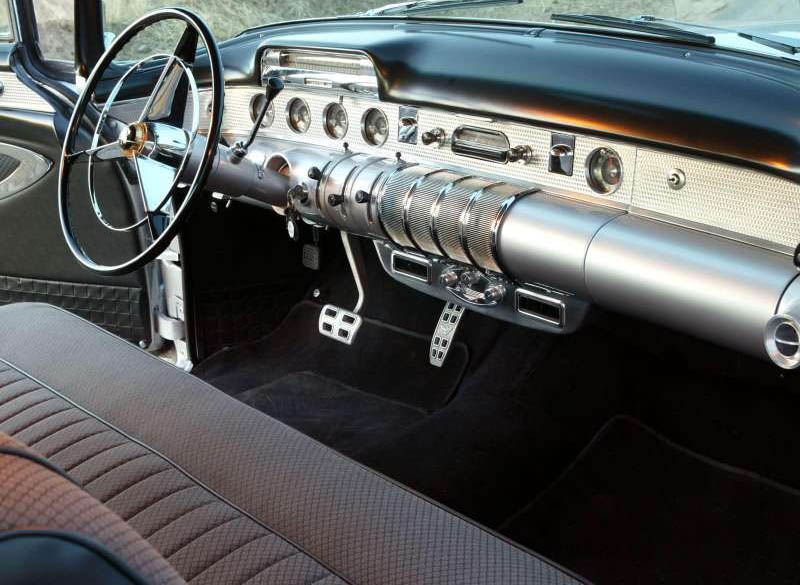
Buick Jay Lenos Roadmaster, 1955

Buick Jay Lenos Roadmaster, 1955


The origins of the Roadmaster name date to 1936 when Buick renamed its entire model line-up to celebrate the engineering improvements and design advancements over their 1935 models. Buick's Series 40 model range became the Special, the Buick Century took the place of the Series 60 and the Series 90 — Buick's largest and most luxurious vehicles — became the Limited. Buick's Series 80 became the Roadmaster.

Roadmasters produced between 1936 and 1958 were built on Buick's longest wheelbase and shared its basic structure with senior Oldsmobiles. Between 1946 and 1957, the Roadmaster was Buick's premium and best appointed model, and was offered in sedan, coupe, convertible and station wagon bodystyles between 1936 and 1948. In 1949 a hardtop coupe, designated "Riviera" joined the model line up; a four-door hardtop joined the model range in 1956.

The 1953 Buick Roadmaster station wagon, Model 79-R, was the last wood-bodied station wagon mass-produced in the United States. Its body was a product of Iona Manufacturing which built all Buick station wagon bodies between 1946 and 1964. Priced at US$4,031, the wagon was second in price to the Buick Skylark. Only 670 of these final woody wagons were produced for 1953.

In 1959 Buick again introduced a model range that represented a significant shift in its body design, and the Roadmaster name was replaced by the Electra name.

Buick Skylark, 1953

Buick Skylark, 1953


Introduced to mark Buick's 50th anniversary, the Buick Skylark (first use of the name for a production vehicle) on one of three specialty convertibles produced in 1953 by General Motors; the other two were the Oldsmobile Fiesta and the Cadillac Eldorado. All three were limited production vehicles promoting General Motors' design leadership. Of the three, the Skylark had the most successful production run with 1,690 produced. This was considered quite an amazing sales feat, for the car had a list price in 1953 of slightly in excess of US$5,000. However, many languished in dealer showrooms and were sold at discount.

All 1,069 regular-production Skylarks built in 1953 (and all in 1954) were convertibles. The 1953s were based on the 2-door Roadmaster, having identical dimensions (except height), almost identical convenience and appearance equipment, and a Roadmaster drive train. In 1953, the model designation for the Skylark was 76X, while the model designation for the Roadmaster convertible was 76R. The few options available to the Roadmaster convertible buyer were standard equipment to the Skylark buyer, albeit the base price for the well-equipped Roadmaster convertible was only about US$3,200.

The 1953 Skylark featured V8 power and a 12 volt electrical system, both a first for Buick, as well as full-cutout wheel openings, a styling cue that would make its way to the main 1954 Buick line. Also making its way into the 1954 Buick line was the cut-down door at the base of the side window line that bounced back up to trace around the rear window (or convertible top). This styling clue stayed with Buick for many years and can be found on any number of automobile brands to this day.

The 1953 Buick Skylark was a handmade car in many respects. The stampings for the hood, trunk lid and a portion of the convertible tub were the same as the 1953 Roadmaster convertible (and Super convertible, model 56R). The stampings for the front fenders, rear fenders, the outer doors, and a portion of the convertible tub were unique to the Skylark. All Skylark convertible tubs were finished with various amounts of lead filler. It is not unusual to find a substantial amount of lead filler just behind the doors near the bottom of the window line. The inner doors of the Skylark were made from the inner doors of the 2-door Roadmaster and Super by cutting the stamping in half approximately parallel with the ground and then welding the two pieces back together in a jig at an angle that produced the necessary door dip (see photos of finished car).

Though there were many unique design features of the 1953 Skylark, one that goes almost unnoticed today is that the top and seating of the car were lowered a few inches below the Roadmaster and Super convertibles. This was achieved not by changing the frame, body or suspension, but by cutting the windshield almost three inches shorter and lowering the side windows and convertible top frame. To accommodate people without bumping their heads with the top up, the seat frames and steering column were lowered.

The wheels of the 1953 Skylark were true wire wheels, produced by Kelsey-Hayes, with everything chromed save for the plated and painted "Skylark" center emblem. Although this was high style in 1953, the wheels were heavier than the regular steel wheels, would require periodic truing to keep them straight and balanced, and required tubes within the tires just when tubeless tires were becoming the norm, as they were throughout the rest of the Buick line.

For 1954, the Skylark returned, although radically restyled. This Skylark featured elongated wheel cutouts, the interior of which were available painted a contrasting color to the body color. For example, black cars could receive white or red wheel wells. The trunk of the restyled Skylark was sloped into a semi-barrel shape. Tail lights were housed in large chromed fins that projected from the tops of the rear fenders.

The car was now based on the all-new shorter Century/Special chassis and not the top-of-the-line Roadmaster/Super chassis, also all-new for 1954. However, it did share the Roadmaster and Century powertrain, the highest output in the 1954 Buick model lineup. This powertrain was an evolutionary improvement, but very similar to the 1953 powertrain.

The model designation for the 1954 Buick Skylark was "100", a completely unique designation. The short wheelbase cars were the Buick Special: series 40, the Buick Century: series 60, and the Buick Skylark: series 100, albeit a series of just one model. All production Buick Skylarks were built as 2-door convertibles. They had the same luxury equipment as the 1953 Buick Skylarks.

Like their 1953 counterparts, the 1954 Skylark had a number of unique sheetmetal stampings, but without the hand labor that went into the 1953 Skylark production. In addition to unique front and rear fenders with the elongated wheel cutouts, the 1954 Skylark had a unique trunk with its semi-barrel shape and huge, rounded chrome fins. Interestingly, the hood was also unique to the 1954 Skylark in a small way. The hood ornament was quite different from all other Buick models for the 1954 model year. However, this same hood ornament, although unique in size to just this one model in 1954, was to portend the design of the 1955 Buick hood ornament used on all models of that year.

The cost of the Skylark, mixed with the public's dislike for the restyle and its perceived step down in rank to the Special/Century series versus the 1953 rank with the Super/Roadmaster series resulted in poor sales and the car's demise at the end of the 1954 model year.

Buick Le Sabre, 1951

Buick Le Sabre, 1951


Buick Le Sabre, 1951

Buick XP-300 Concept, 1951

Buick XP-300 Concept, 1951


Buick XP-300 Concept, 1951

Buick Super Convertible, 1951

Buick Super Convertible, 1951


Buick Super Convertible, 1951