
Showing posts with label 2009. Show all posts
Showing posts with label 2009. Show all posts
Monday, April 4, 2011
2009 Hot Wheels Synkro Track Stars
Below is a picture of the 2009 Hot Wheels Synkro and is number #063 in the Track Stars series. It has a Red paint job, with Yellow, Black, Gold, and White tampos, Number '8' on the sides and hood, Unpainted Malaysia Base, with Red and Black OH5SP wheels.


Wednesday, March 2, 2011
Honda Skydeck Concept, 2009
Honda Skydeck Concept, 2009


The Honda Skydeck Concept, an innovative 6-seater hybrid MPV. This is still a design study, but is a great example of how Honda's IMA technology can be placed in a range of different cars for different needs. To give the Honda Skydeck Concept the practicality of a conventional MPV, many of the hybrid system components - including the high power battery - are housed in the car's centre tunnel (rather than behind the rear seats or under the floor, as with previous production hybrids). This allows for greater cabin space, and the room for three rows of two seats. It also gives a lower centre of gravity.
Honda P-NUT Concept,2009
Honda P-NUT Concept,2009


The Honda P-NUT Concept (Personal-Neo Urban Transport) demonstrates a futuristic concept for an ultra-compact and sophisticated city coupe, American Honda Motor Co., Inc., announced at the 2009 Los Angeles Auto Show.
Conceived around a small "footprint" for maximum convenience in tight urban settings, the packaging concept integrates a center driving position configuration and a rear powertrain layout. The exterior styling leverages crisp angles with dynamic flowing lines that originate from the front of the vehicle and span outward toward the rear. The end result is a sleek and aggressive exterior that also allows for a spacious and open interior with excellent visibility.
The exterior styling is intended to capture a future direction for premium sophistication while balancing the need for maximum interior space and an aerodynamic appearance. The interior layout, in conjunction with the rear powertrain design, contributes prominently to the exterior's overall shape.
The layout of the interior space, with its center driving position flanked by two rear seats, provides generous legroom for all occupants, roughly the equivalent of a mid-sized sedan in a vehicle that has an exterior footprint similar to a micro car. Interior functionality is increased by rear seating areas that fold up and out of the way to increase storage capacity. The windshield serves as a heads-up display for the navigation system and the back-up camera.
The modular rear engine bay, depicted on the exterior by blue composite material, is designed to accommodate a wide variety of potential propulsion technologies including a conventional small displacement internal combustion engine, a hybrid gasoline-electric powertrain, or a battery-electric powertrain.
The Advanced Design Studio of Honda R&D Americas, Inc. in Los Angeles developed the Honda P-NUT Concept. Honda R&D Americas began its operations in California in 1975 with local market research activities and has steadily grown its capabilities over the past 33 years to include all aspects of new vehicle research, design and development. Recent Honda-brand efforts include trend-setting products such as the Pilot, Ridgeline, Element, Civic Coupe and Civic Si Coupe.
Specifications
* Size class: Ultra-compact
* Layout: Rear-engine, rear-wheel-drive
* Passengers: 3
* Length: 3,400 mm
* Width: 1,750 mm
* Height: 1,439 mm
* Powertrain: Internal-combustion engine, hybrid-electric or battery-electric
Honda 3R-C Concept, 2009
Honda 3R-C Concept, 2009


Honda 3R-C Concept, a revolutionary three wheeled battery electric vehicle concept, shows what a future minimal urban transport vehicle for one person might look like. The battery electric drivetrain is mounted low in the three wheeled chassis, therefore keeping the centre of gravity low and thus improving stability.
The Honda 3R-C Concept has a clear canopy that covers the driver's seat while it is parked and not in use. When 3R-C vehicle is in motion, the canopy becomes an enveloping wind-shield that provides the pilot, who sits low in the vehicle, with significant protection from the bodywork and doors.
The high sides of the safety shell seat give greater safety to the occupant, reducing the threat from side impacts and improving weather protection. In front of the driver is a lockable boot area, which gives significant secure storage for luggage or other items. The Honda 3R-C Concept's designers created a flexible cover that surrounds the upper torso to reduce exposure to bad weather and improving comfort.
The Honda 3R-C Concept study was created by European designers working at Honda's Research and Design facility in Milan.
Buick Business Concept, 2009
Buick Business Concept, 2009


The Buick Business Concept, a new concept vehicle designed to showcase Buick's future vision of "business class on the road".
The multi-purpose vehicle (MPV) was developed in China by the Pan Asia Technical Automotive Center (PATAC), a design and engineering joint venture between General Motors and Shanghai Automotive Industry Corporation (SAIC), with global design input.
The Buick Business Concept Vehicle captures the essence of the Buick form language in a thoroughly elegant and expressive design, with its taut surfaces, double sweep spear belt line, strong front and rear identities and dynamic presence.
Classic Influences in Modern Design
According to Cao Min, PATAC Concept Car Chief Designer, the design team set out to create a modern global design for Buick, yet include a subtle Chinese essence and influence. To achieve this balance, they sought to draw from their heritage outside the automotive industry - from classic shapes to arts and ancient relics.
The Buick Business Concept Vehicle's dynamic exterior surfaces and "yin and yang" interior tones are drawn from diverse inspirations including the 2008 Buick Riviera concept car, Chinese artifacts and modern electronic icons. The vehicle, inside and out, communicates an orderly elegance that transcends cultural boundaries and conveys the tranquility and power of Buick.
The Exterior Design - A Sense of Presence and Buick Essence
To establish their design direction, PATAC designers took the global Buick design vocabulary of sculpturally beautiful and dynamic forms established by the Riviera concept car and successfully extended it to a tall, one-box architecture.
The Buick Business Concept Vehicle develops the Buick form language further and incorporates elements of Chinese culture and artistic influences into the details. It takes the Buick design treatment to a new level of sophisticated boldness.
The Power sliding doors with no B-pillar were selected for their ability to showcase an expansive view of the interior and ease of entrance and egress.
The Buick Business Concept Vehicle sits on 20-inch, 9-spoke forged aluminum wheels, with a polished mirror finish, and low-profile tires. The outside mirrors incorporate turn signals with the huiwen motif.
The Interior Design - Functionality and Soothing Serenity
Serenity and advanced functionality come to mind when entering the vehicle. The use of deep burgundy suede and subtle creams, representing earth and wood themes, are conveyed through high-quality leather bucket seats, plush vehicle carpet and a luxurious padded steering wheel. Completing the tranquil feel is a roof comprised of two full-length sunroofs that offer a celestial connection for occupants.
The Interior trim and features befitting Buick prestige abound such as a power central console with a deployable tablet for writing or to hold a laptop computer. The console can be moved up and down the two rows of rear seats. The second row of power captain's chairs slide on hidden rails and swivel 225 degrees, enabling them to be adjusted to an infinite combination of orientations. Traditional huiwen patterns are embroidered onto the seats and seat backs, bringing harmony to the entire design theme.
The multi-purpose vehicle (MPV) was developed in China by the Pan Asia Technical Automotive Center (PATAC), a design and engineering joint venture between General Motors and Shanghai Automotive Industry Corporation (SAIC), with global design input.
The Buick Business Concept Vehicle captures the essence of the Buick form language in a thoroughly elegant and expressive design, with its taut surfaces, double sweep spear belt line, strong front and rear identities and dynamic presence.
Classic Influences in Modern Design
According to Cao Min, PATAC Concept Car Chief Designer, the design team set out to create a modern global design for Buick, yet include a subtle Chinese essence and influence. To achieve this balance, they sought to draw from their heritage outside the automotive industry - from classic shapes to arts and ancient relics.
The Buick Business Concept Vehicle's dynamic exterior surfaces and "yin and yang" interior tones are drawn from diverse inspirations including the 2008 Buick Riviera concept car, Chinese artifacts and modern electronic icons. The vehicle, inside and out, communicates an orderly elegance that transcends cultural boundaries and conveys the tranquility and power of Buick.
The Exterior Design - A Sense of Presence and Buick Essence
To establish their design direction, PATAC designers took the global Buick design vocabulary of sculpturally beautiful and dynamic forms established by the Riviera concept car and successfully extended it to a tall, one-box architecture.
The Buick Business Concept Vehicle develops the Buick form language further and incorporates elements of Chinese culture and artistic influences into the details. It takes the Buick design treatment to a new level of sophisticated boldness.
The Power sliding doors with no B-pillar were selected for their ability to showcase an expansive view of the interior and ease of entrance and egress.
The Buick Business Concept Vehicle sits on 20-inch, 9-spoke forged aluminum wheels, with a polished mirror finish, and low-profile tires. The outside mirrors incorporate turn signals with the huiwen motif.
The Interior Design - Functionality and Soothing Serenity
Serenity and advanced functionality come to mind when entering the vehicle. The use of deep burgundy suede and subtle creams, representing earth and wood themes, are conveyed through high-quality leather bucket seats, plush vehicle carpet and a luxurious padded steering wheel. Completing the tranquil feel is a roof comprised of two full-length sunroofs that offer a celestial connection for occupants.
The Interior trim and features befitting Buick prestige abound such as a power central console with a deployable tablet for writing or to hold a laptop computer. The console can be moved up and down the two rows of rear seats. The second row of power captain's chairs slide on hidden rails and swivel 225 degrees, enabling them to be adjusted to an infinite combination of orientations. Traditional huiwen patterns are embroidered onto the seats and seat backs, bringing harmony to the entire design theme.
Friday, February 18, 2011
Toyota FT-EV Concept, 2009
Toyota FT-EV Concept, 2009

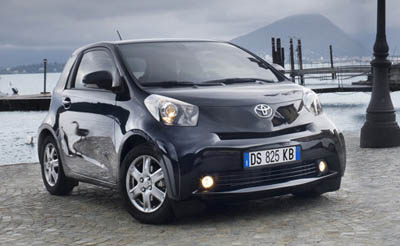


The DESIGN
The objective was a new kind of city car, one that would accommodate four people within an overall length of less than three metres. The result was a landmark solution that will have a long term influence on Toyota's future vehicle development. Toyota iQ is the ultimate expression of refined, yet environmentally efficient urban mobility.
The extraordinary interior space in a car that measures just 2,985mm long, 1,500mm high and 1,680mm wide is a tribute to the determination and ingenuity of Toyota's design and engineering team.
It can carry four people (three adults plus a child) in comfort and safety at motorway speeds, is just the beginning of the story. Starting with a clean sheet of paper, Toyota has created an ingenious and distinctive new city car. And with its proportionally large, 2,000mm wheelbase, Toyota iQ has a compact yet muscular stance that is like no other car.
Toyota iQ's design represents the essence of Toyota's J-factor heritage, which embraces the finest elements of Japanese aesthetics, such as miniaturisation and modernism. Most importantly it brings contradictory elements into harmony, such as "small yet spacious" or "hi-tech yet human".
SIX INNOVATIONS PRODUCE A BREAKTHROUGH IN VEHICLE PACKAGING
Toyota iQ's remarkable interior volume is down to its comparatively long 2,000mm wheelbase and short overhangs - 530mm at the front and 455mm at the rear. Interior length from the rear end of the instrument panel to the hip point of the rear seats is an impressive 1,238mm. To achieve this breakthrough, six space-saving engineering innovations were developed.
Integrating the front-mounted differential in a conventional transmission layout allowed Toyota iQ to be built with an ultra-short front overhang. This reduced overall length while at the same time increasing the length of the passenger compartment. Ingeniously this not only reduces the amount of space required for the engine compartment, it also allows the large diameter front wheels to be positioned at the far corners of the vehicle. This shortens the overhangs, which in turn improves stability and manoeuvrability.
Employing centre take-off steering gear and placing it higher in the engine bay means the transmission, engine and differential could be repositioned. The engine compartment could then be made considerably smaller, further reducing the front overhang.
The traditionally fuel tanks are located underneath a car's rear seats. By making the tank flat, reducing it to just 120mm in height and solving the problems of rapidly changing fuel surface levels that such a design would normally create, the tank could be relocated under the floor. Toyota iQ's fuel tank has a 32-litre capacity, giving an ample driving range. Angling the rear shock absorbers backwards allows interior rear space to be increased.
The slimness of the seatbacks frees up an extra 40mm of rear passenger room at knee height. The seats weigh up to 30 per cent less than conventional ones, contributing to overall fuel efficiency and low emissions. Using extruded pipe materials rather than high tensile sheet steel ensures the structure is rigid. The slimmer designs, with integrated headrests, save space without sacrificing comfort or safety.
Reducing the size of the heater and air conditioning unit by 20 per cent compared to the Toyota Yaris allowed the engineers to make significant space savings without compromising performance. This means the blower unit, usually found in front of the front passenger, could be integrated with the main ventilation unit in a central position. This innovation allowed the front passenger area to be moved forward, freeing up cabin space and increasing leg room.
The innovative asymmetric dashboard was designed to open up the whole cabin area. It ensures ample leg room for the front passenger, even when the seat is in its furthest forward position. The sliding seat configuration allows an adult 190cm tall to sit comfortably in the rear seat behind a front passenger of the same height. Shoulder-to-shoulder distance between driver and front passenger is 50mm wider than in Yaris and bears comparison with a C-segment vehicle. The all-round space and seating layout means there is ample room for three adults plus either a child passenger or luggage behind the driver.
ENGINEERED FOR ENVIRONMENTAL EXCELLENCE
The Toyota iQ represents the successful outcome of Toyota's well-established drive to reduce the environmental impact of its vehicles without compromising performance and driving dynamics. With CO2 emissions as low as 99g/km (with manual transmission), it is clearly a city car that's in the right place at the right time.
Its innovative, aerodynamic packaging has been achieved through a low overall height, low centre of gravity and wheels pushed out to the four corners of the car. This gives agility at low speed and unprecedented stability for a small car on motorways and winding roads. A minimum turning radius of 3.9 metres further enhances its nimble handling, even in tight city streets.
The 1.0-litre VVT-i petrol engine, winner of the 2008 Engine of the Year award in the sub-1.0-litre class, is a lightweight, three-cylinder unit, producing 67bhp (68 Din hp) at 6,000rpm and 91Nm of torque at 4,800rpm. Combined with a high-ratio five-speed manual transmission, it returns 65.7mpg in combined cycle driving and 99g/km of carbon dioxide (figures provisional prior to final homologation). This keeps Toyota iQ under the UK's 100g/km threshold for Vehicle Excise Duty, a benchmark that is also used for tax purposes in other major European markets, too. Specified with Multidrive transmission, the engine emits 110g/km of CO2 (provisional figure).
The Multidrive transmission
Multidrive uses Toyota's latest continuously variable transmission (CVT) technology to give a very smooth shift feel while optimising the balance between performance and fuel economy. It continuously monitors and selects the most appropriate gear ratio and shifting speed, automatically eliminating "shift shock" or jumps while changing gear. It maximises engine torque without unnecessary acceleration and smoothes gear ratio changes, for example limiting uphill shifts and making downhill shifts to achieve optimum engine brake force. The system provides all the city-friendly characteristics of a conventional automatic gearbox.
Models equipped with Multidrive feature an ECO driving indicator lamp on the multi-information display. This encourages more economical driving by signalling when fuel is being saved and, consequently, emissions are reduced. Current and average fuel consumption are also permanently on display.
The Gear shift indicator
Models with manual transmission are equipped with a gear shift indicator which shows the driver when to change up or down a gear to achieve the best environmental performance. The system takes driving conditions, accelerator pedal pressure and vehicle speed into account and can return fuel consumption savings of between 0.5 and three per cent compared to normal gear shifting, depending on individual driver habits.
The Future developments
The Toyota iQ's innovations will be adapted and evolved for future Toyota models. The car is a major milestone in Toyota's environmental commitment and efforts to develop technologies for much lower emissions.
The objective was a new kind of city car, one that would accommodate four people within an overall length of less than three metres. The result was a landmark solution that will have a long term influence on Toyota's future vehicle development. Toyota iQ is the ultimate expression of refined, yet environmentally efficient urban mobility.
The extraordinary interior space in a car that measures just 2,985mm long, 1,500mm high and 1,680mm wide is a tribute to the determination and ingenuity of Toyota's design and engineering team.
It can carry four people (three adults plus a child) in comfort and safety at motorway speeds, is just the beginning of the story. Starting with a clean sheet of paper, Toyota has created an ingenious and distinctive new city car. And with its proportionally large, 2,000mm wheelbase, Toyota iQ has a compact yet muscular stance that is like no other car.
Toyota iQ's design represents the essence of Toyota's J-factor heritage, which embraces the finest elements of Japanese aesthetics, such as miniaturisation and modernism. Most importantly it brings contradictory elements into harmony, such as "small yet spacious" or "hi-tech yet human".
SIX INNOVATIONS PRODUCE A BREAKTHROUGH IN VEHICLE PACKAGING
Toyota iQ's remarkable interior volume is down to its comparatively long 2,000mm wheelbase and short overhangs - 530mm at the front and 455mm at the rear. Interior length from the rear end of the instrument panel to the hip point of the rear seats is an impressive 1,238mm. To achieve this breakthrough, six space-saving engineering innovations were developed.
Integrating the front-mounted differential in a conventional transmission layout allowed Toyota iQ to be built with an ultra-short front overhang. This reduced overall length while at the same time increasing the length of the passenger compartment. Ingeniously this not only reduces the amount of space required for the engine compartment, it also allows the large diameter front wheels to be positioned at the far corners of the vehicle. This shortens the overhangs, which in turn improves stability and manoeuvrability.
Employing centre take-off steering gear and placing it higher in the engine bay means the transmission, engine and differential could be repositioned. The engine compartment could then be made considerably smaller, further reducing the front overhang.
The traditionally fuel tanks are located underneath a car's rear seats. By making the tank flat, reducing it to just 120mm in height and solving the problems of rapidly changing fuel surface levels that such a design would normally create, the tank could be relocated under the floor. Toyota iQ's fuel tank has a 32-litre capacity, giving an ample driving range. Angling the rear shock absorbers backwards allows interior rear space to be increased.
The slimness of the seatbacks frees up an extra 40mm of rear passenger room at knee height. The seats weigh up to 30 per cent less than conventional ones, contributing to overall fuel efficiency and low emissions. Using extruded pipe materials rather than high tensile sheet steel ensures the structure is rigid. The slimmer designs, with integrated headrests, save space without sacrificing comfort or safety.
Reducing the size of the heater and air conditioning unit by 20 per cent compared to the Toyota Yaris allowed the engineers to make significant space savings without compromising performance. This means the blower unit, usually found in front of the front passenger, could be integrated with the main ventilation unit in a central position. This innovation allowed the front passenger area to be moved forward, freeing up cabin space and increasing leg room.
The innovative asymmetric dashboard was designed to open up the whole cabin area. It ensures ample leg room for the front passenger, even when the seat is in its furthest forward position. The sliding seat configuration allows an adult 190cm tall to sit comfortably in the rear seat behind a front passenger of the same height. Shoulder-to-shoulder distance between driver and front passenger is 50mm wider than in Yaris and bears comparison with a C-segment vehicle. The all-round space and seating layout means there is ample room for three adults plus either a child passenger or luggage behind the driver.
ENGINEERED FOR ENVIRONMENTAL EXCELLENCE
The Toyota iQ represents the successful outcome of Toyota's well-established drive to reduce the environmental impact of its vehicles without compromising performance and driving dynamics. With CO2 emissions as low as 99g/km (with manual transmission), it is clearly a city car that's in the right place at the right time.
Its innovative, aerodynamic packaging has been achieved through a low overall height, low centre of gravity and wheels pushed out to the four corners of the car. This gives agility at low speed and unprecedented stability for a small car on motorways and winding roads. A minimum turning radius of 3.9 metres further enhances its nimble handling, even in tight city streets.
The 1.0-litre VVT-i petrol engine, winner of the 2008 Engine of the Year award in the sub-1.0-litre class, is a lightweight, three-cylinder unit, producing 67bhp (68 Din hp) at 6,000rpm and 91Nm of torque at 4,800rpm. Combined with a high-ratio five-speed manual transmission, it returns 65.7mpg in combined cycle driving and 99g/km of carbon dioxide (figures provisional prior to final homologation). This keeps Toyota iQ under the UK's 100g/km threshold for Vehicle Excise Duty, a benchmark that is also used for tax purposes in other major European markets, too. Specified with Multidrive transmission, the engine emits 110g/km of CO2 (provisional figure).
The Multidrive transmission
Multidrive uses Toyota's latest continuously variable transmission (CVT) technology to give a very smooth shift feel while optimising the balance between performance and fuel economy. It continuously monitors and selects the most appropriate gear ratio and shifting speed, automatically eliminating "shift shock" or jumps while changing gear. It maximises engine torque without unnecessary acceleration and smoothes gear ratio changes, for example limiting uphill shifts and making downhill shifts to achieve optimum engine brake force. The system provides all the city-friendly characteristics of a conventional automatic gearbox.
Models equipped with Multidrive feature an ECO driving indicator lamp on the multi-information display. This encourages more economical driving by signalling when fuel is being saved and, consequently, emissions are reduced. Current and average fuel consumption are also permanently on display.
The Gear shift indicator
Models with manual transmission are equipped with a gear shift indicator which shows the driver when to change up or down a gear to achieve the best environmental performance. The system takes driving conditions, accelerator pedal pressure and vehicle speed into account and can return fuel consumption savings of between 0.5 and three per cent compared to normal gear shifting, depending on individual driver habits.
The Future developments
The Toyota iQ's innovations will be adapted and evolved for future Toyota models. The car is a major milestone in Toyota's environmental commitment and efforts to develop technologies for much lower emissions.
Toyota FT-EV Concept, 2009
Toyota FT-EV Concept, 2009


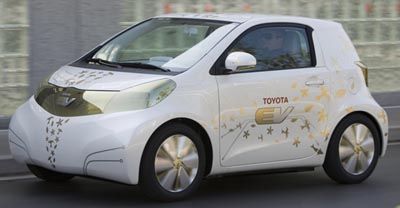


The Toyota FT-EV concept shares its platform with the revolutionary-new Toyota iQ urban commuter vehicle. Already a huge hit in Japan, the iQ is lightweight and seats four passengers in comfort and security, while delivering exceptional mileage, sporty performance, unique refinements and a fun, youthful image.
Toyota FT-EV concept imagines an urban dweller, driving up to 50 miles between home, work and other forms of public transportation, such as high-speed rail. Although, for now, the Toyota FT-EV remains a pure concept, it represents a natural pairing of product strategies.
Though BEVs and new smaller vehicles like the iQ will be a key component of Toyota's sustainable mobility strategy, the conventional gas-electric hybrid, like the all new third-generation Prius, is considered Toyota's long-term core powertrain technology.
The first-generation lithium-ion batteries powering these PHVs will be built on an assembly line at Toyota's PEVE (Panasonic EV Energy Company, LTD) battery plant, a joint-venture production facility in which Toyota owns 60 percent equity. During its development, the new Prius was designed and engineered to package either the lithium-ion battery pack with plug-in capability, or the nickel-metal hydride battery for the conventional gas-electric system.
The 500 PHVs arriving globally in late 2009 will be used for market and engineering analysis. Lease-fleet customers will monitor the performance and durability of the first-generation lithium-ion battery, while offering real world feedback on how future customers might respond to the plug-in process.
Wednesday, February 9, 2011
Acura ZDX Concept, 2009
Acura ZDX Concept, 2009


The Acura ZDX Concept is designed to break new ground for Acura in the areas of provocative styling, contemporary luxury and meticulous refinement. With its sensuous curves, sharply raked roofline and bold fender flares, the Acura ZDX Concept blurs the distinction between coupe, sedan and sport utility vehicle. Clean, flowing lines start from the headlights and run the length of the car, accentuating the cars presence and grace. In keeping with the coupe-inspired styling, the rear door handles are cleverly concealed in the C-pillar. The all-glass tailgate opens wide to reveal a highly functional cargo space with integrated under-floor storage. The prototype is finished off with stylish dual chrome exhaust outlets and 9-spoke machined wheels fitted with 20-inch Michelin tires.
The inside, the Acura ZDX Concept exudes modern luxury while focusing on pampering the front passengers. The cabin is enveloped in leather, which gives the interior a luxurious and inviting feel. The hand-stitched leather dash and instrument panel sweep down to form a dual cockpit layout, creating a personal and intimate experience for the front seat occupants. The premium leather seats are highly bolstered to support the passengers during sporty driving and at the same time provide comfort during a long getaway. A black monochromatic center stack leads to the textured metallic center console, which complements the black and pearl white leather trim. The thick leather wrapped steering wheel provides ample grip and is framed by racing-inspired paddle shifters for the ultimate in driver control. The cabin is enclosed by a panoramic glass roof which runs the entire length of the vehicle, providing occupants with a breathtaking view of the world around them.
Acura TSX, 2009
Acura TSX, 2009


The Acura provided a one-two punch with the world debut of the all-new second-generation Acura TSX sports sedan along with the appearance of the redesigned RL luxury performance sedan at the New York International Auto Show today. With new engines, refined drivetrain, and Acura's latest Keen Edge Dynamic styling, the all-new Acura TSX and RL highlight a new direction for Acura sedans.
Merging crisp, dynamic design with a bold new signature Acura grille, the 2009 Acura TSX is more distinctive and sporty. Due to its greater length and width, wider track, and longer wheelbase, the new Acura TSX provides additional interior room while new fully independent front and rear suspension with dual-stage dampers provides more agile handling.
Designed with an emphasis on safety, the 2009 Acura TSX now makes use of Acura's esteemed Advanced Compatibility Engineering™ (ACE™) body structure. The 2009 Acura TSX, with ACE™ and a host of other safety features, is expected to achieve the highest ratings in both governmental (NHTSA)* and independent (IIHS) crash testing - including IIHS's TOP SAFETY PICK.
Merging crisp, dynamic design with a bold new signature Acura grille, the 2009 Acura TSX is more distinctive and sporty. Due to its greater length and width, wider track, and longer wheelbase, the new Acura TSX provides additional interior room while new fully independent front and rear suspension with dual-stage dampers provides more agile handling.
Designed with an emphasis on safety, the 2009 Acura TSX now makes use of Acura's esteemed Advanced Compatibility Engineering™ (ACE™) body structure. The 2009 Acura TSX, with ACE™ and a host of other safety features, is expected to achieve the highest ratings in both governmental (NHTSA)* and independent (IIHS) crash testing - including IIHS's TOP SAFETY PICK.
Subscribe to:
Posts (Atom)